The claim
The January 2024 New Hampshire robocall discouraging participation in the primary carried an authentic message spoken by Joe Biden.
How this check was done
This is a retrospective review of published records, researched on 22 September 2026. It is not eyewitness reporting or a new forensic examination. The evidence record identifies what each source establishes and where our review stops.
Two identity questions
Ask separately whether the speaker is authentic and whether the displayed caller identity is authentic. Confidence in one should not be treated as proof of the other. This review uses an attributable record instead of asking readers to decide by ear.
How to handle a similar recording
Keep the message and its context, then verify the claimed announcement through an independently located official channel. If a message concerns voting, check the relevant election authority’s current information rather than treating a forwarded recording as instructions.
The evidence record
The agency identifies the artificial voice and the campaign.
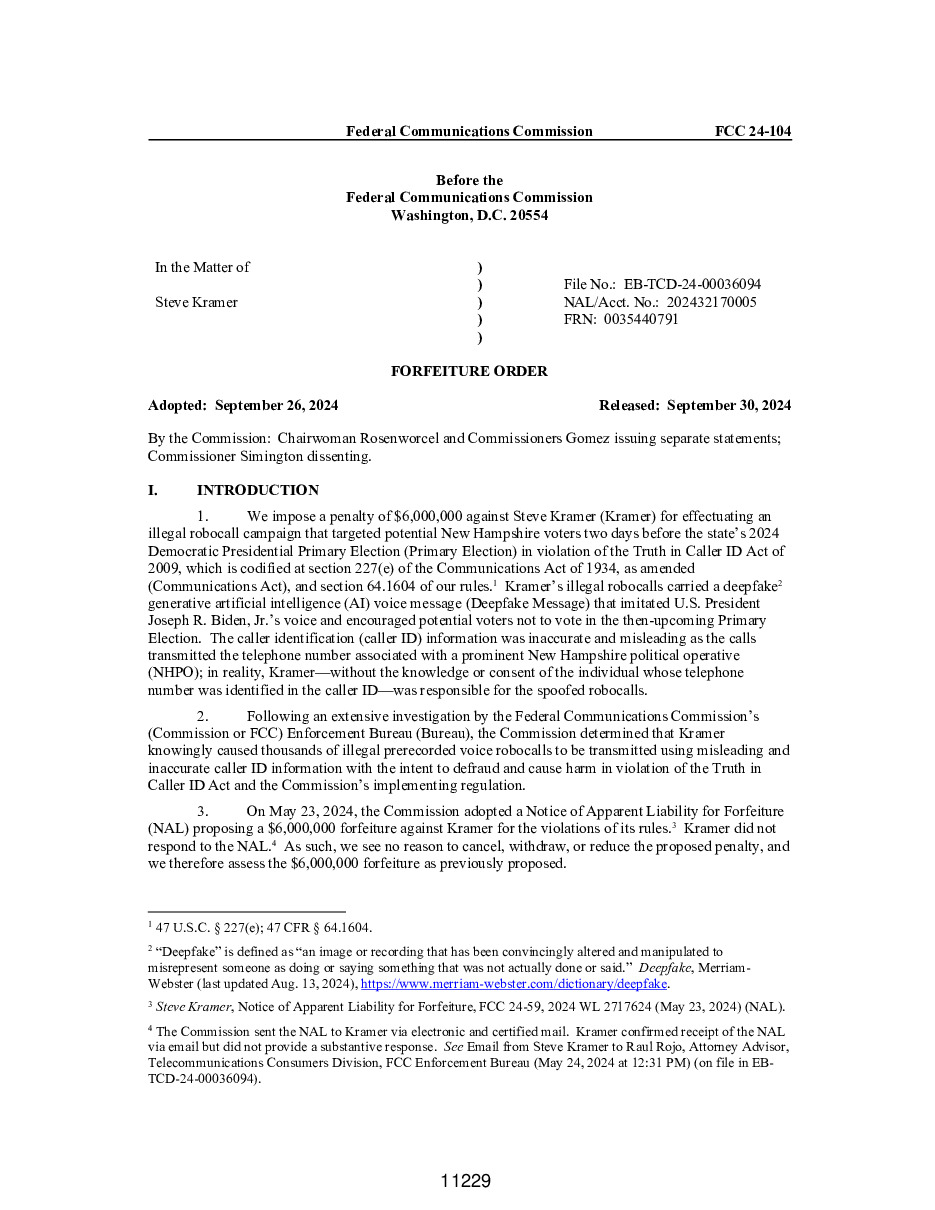
The FCC’s September 2024 order describes calls targeting New Hampshire voters before the primary, using a generative-AI voice imitation and misleading caller identification. [fcc]
Limits: We rely on the dated agency record. We did not independently analyse the audio or reconstruct call routing.
Sources: fcc
Our conclusion
AI GENERATED: the record supports a synthetic origin for the Biden-like voice in the identified robocall.
Confidence and limitations
Strong confidence in the documented voice-origin finding. We assign no detector percentage.
We have not reviewed every call variant. This is not an account of the current status of any fine, appeal or separate criminal proceedings.
Methods, technical checks and limitations
Source and provenance
The source is a named FCC order concerning the historical campaign. Its document number allows readers to identify the exact record.
Media analysis
No listening test, voice comparison or acoustic-forensics tool was used in this review. We do not present an invented recording as an example.
Metadata and technical findings
No original capture or production file was obtained. Embedded metadata was not independently examined.
Reverse-image and source matching
The finding is limited to the campaign identified by the FCC. A recording received today requires its own origin check.
Detector and tool signals
No AI detector was run. No detector score contributes to this finding.
Independent evidence
This review cites an institutional finding rather than a second independent technical reconstruction.
Sources and further reading
- Steve Kramer — Forfeiture Order, FCC 24-104
Federal Communications Commission · primary: dated agency finding · Accessed 2026-09-22
Source published: 2024-09-30
Updates and corrections
- 22 September 2026 — First publication following human review.