The claim
Online video adverts in which a well-known financial personality appears to recommend an investment with large returns, the pattern described in a Police Service of Northern Ireland warning on 7 September 2026, are genuine endorsements.
How this check was done
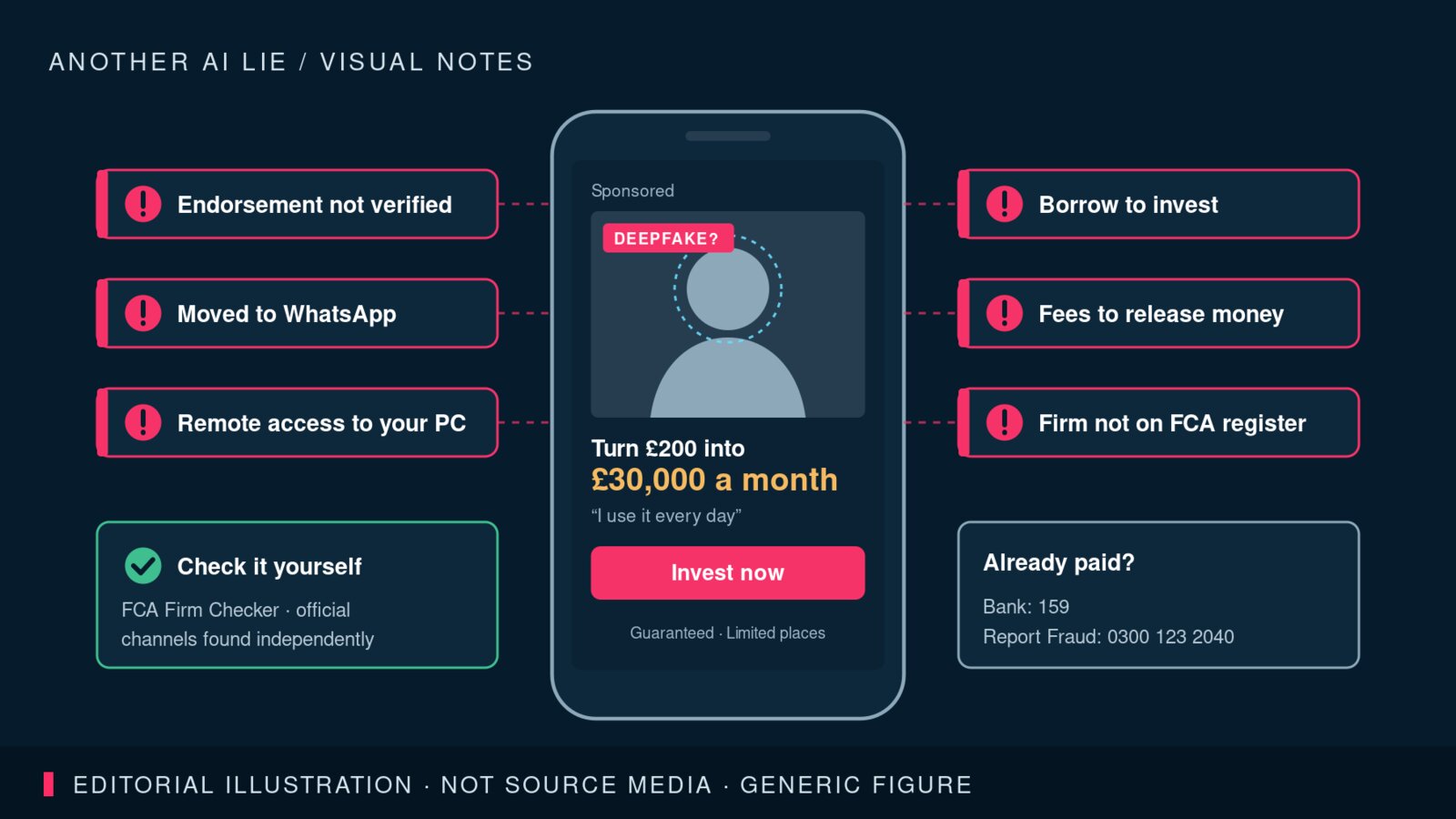
Researched on 23 September 2026. This reviews a documented scam pattern using the Police Service of Northern Ireland’s warning of 7 September 2026, a warning from MoneySavingExpert and the Financial Conduct Authority’s guidance. We did not examine a specific advert: police did not publish the video or name the person it featured. The illustration is our own drawing of the pattern, with a generic figure.
What police described
A video advert of a well-known financial personality promised strong returns. A small first payment was followed by contact on WhatsApp, pressure to open more accounts, remote access to a computer, encouragement to borrow and, finally, demands for more money to release the ‘investment’. Each of those steps is a warning sign in its own right.
A familiar face is not an endorsement
AI tools can imitate faces and voices convincingly, and ordinary editing can put genuine clips into a false context. Either way, a video cannot show that someone recommends an investment. Check the person’s own official website or channels, found independently rather than through the advert.
Before you pay anything
Look up the firm on the FCA Firm Checker at fca.org.uk and compare its reference number and contact details, and check the FCA Warning List. Do not follow links or phone numbers from the advert. If you have paid or shared details, call your bank on 159 and report it to Report Fraud on 0300 123 2040 or at reportfraud.police.uk; in Northern Ireland you can also call police on 101.
The evidence record
The case described by police.
PSNI said the fraud began after the victim saw what appeared to be an AI-generated video featuring a well-known personality from the financial sector, advertising an investment with significant returns. After a small first payment, the victim was contacted on WhatsApp, persuaded to open several online accounts, allowed remote access to a computer, was encouraged to borrow to invest and was told further payments were needed to release the money. The loss was £250,000. [psni]
Limits: Police did not name the personality or publish the video, and described it as appearing to be AI-generated; we have not seen it.
Sources: psni
What police say an advert proves.
Inspector Youle said AI means “videos, voices and apparent endorsements from recognisable people can also be fabricated” and that an online advertisement or apparent celebrity endorsement “should never be regarded as proof that an investment is genuine”. Police advise independently verifying who you are dealing with and checking that a firm is authorised by the Financial Conduct Authority. [psni]
Limits: General police advice arising from one reported case.
Sources: psni
A frequently impersonated presenter on scam adverts.
MoneySavingExpert says Martin Lewis does not do adverts, and has warned about AI-generated scam ads falsely featuring him, including fake BBC pages about a Question Time appearance that never happened and promises of unrealistic returns. [mse]
Limits: Describes adverts using one person’s likeness. It is not evidence about the personality in the PSNI case, whom police did not name.
Sources: mse
The regulator’s check.
The FCA advises checking that a firm’s reference number and contact details match its Firm Checker, warns that some firms pretend to be authorised, and publishes a Warning List of unauthorised firms. [fca]
Limits: Authorisation shows who is regulated; it does not make every product suitable.
Sources: fca
What the records mean for the claim.
In the pattern police and MoneySavingExpert describe, a recognisable face or voice in an advert is used as bait, not as a genuine endorsement. Whether such a video is AI-generated or edited, it cannot show that the person recommends the investment; only an independent check can. [psni] [mse] [fca]
Limits: A pattern finding. Some genuine adverts do feature public figures, and a specific advert needs its own check.
Our conclusion
FAKE: in the documented pattern, a recognisable face or voice in an investment advert is bait, not a genuine endorsement. This is not a verdict on every advert featuring a public figure.
Confidence and limitations
Strong confidence in the pattern as documented by police and MoneySavingExpert. A specific advert needs its own check.
We did not see the advert in the PSNI case, and police did not identify the personality or confirm how the video was made. MoneySavingExpert’s warning concerns one person’s likeness and is not linked to the PSNI case. No AI-generation claim is made about any specific video.
Methods, technical checks and limitations
Source and provenance
The pattern is documented in PSNI’s news release of 7 September 2026 and MoneySavingExpert’s warning of 29 May 2026. No specific advert has been identified or examined here.
Media analysis
No advert or video was examined.
Metadata and technical findings
Not applicable: no file was examined.
Reverse-image and source matching
No reverse image or video search was run, because no specific advert was available.
Detector and tool signals
No AI detector was run. Police described the video as appearing to be AI-generated; we make no finding about how any particular video was made.
Independent evidence
The finding rests on the official police release, the financial regulator’s guidance and a first-party statement from the organisation of a frequently impersonated presenter.
Sources and further reading
- Warning against fraud after victim loses £250,000 in Ards and North Down to online criminals
Police Service of Northern Ireland · official police news release · Accessed 2026-09-23
Source published: 2026-09-07
- Beware these AI-generated scam ads falsely featuring Martin Lewis
MoneySavingExpert · first-party statement from the impersonated presenter’s organisation · Accessed 2026-09-23
Source published: 2026-05-29
- Protect yourself from scams
Financial Conduct Authority · official regulator guidance · Accessed 2026-09-23
Updates and corrections
- 23 September 2026 — Added an original editorial illustration of the scam pattern. The verdict and evidence are unchanged.
Previous verdict: FAKE.
- 23 September 2026 — First publication following human review.