The claim
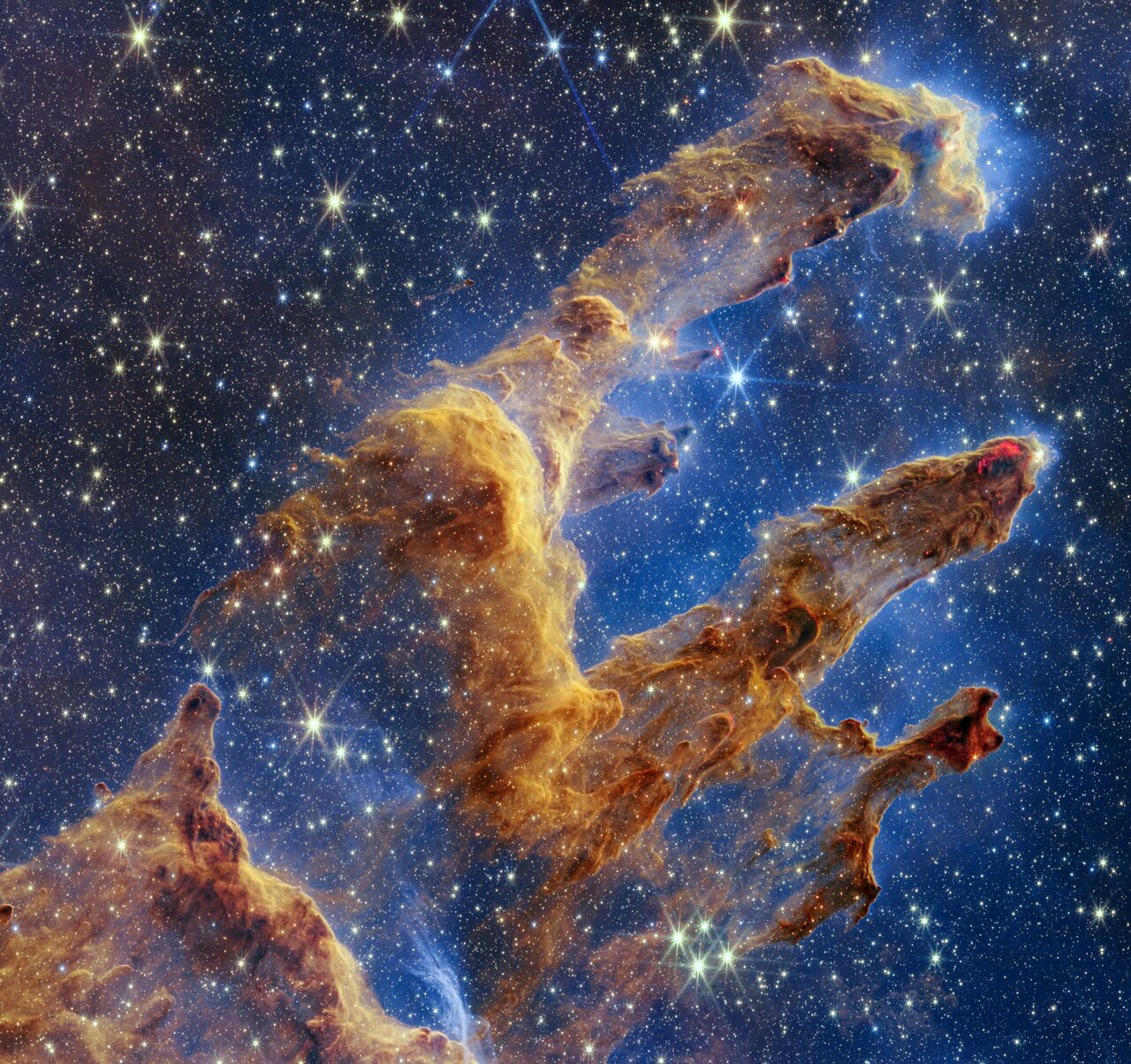
The ESA/Webb NIRCam release identified as weic2218d is based on telescope observations of the Pillars of Creation.
How this check was done
This is a retrospective review of published records, researched on 22 September 2026. It is not eyewitness reporting or a new forensic examination. The evidence record identifies what each source establishes and where our review stops.
Processing is a question to investigate
Ask what information the processing represents and whether the publisher explains it. An image can be informative while requiring a caption to interpret it. The relevant distinction is between a documented measurement and an unsupported claim about what the display shows.
How to check another space image
Find the observatory’s release, record its image identifier and instrument, and compare the exact view. Read the caption before drawing conclusions from colour. If a post strips away that explanation, restore the context when sharing it.
The evidence record
The release identifies the instrument and subject.
ESA/Webb identifies weic2218d as a NIRCam view of the Pillars of Creation. [image]
Limits: We reviewed the published release, not a fresh reduction of telescope data.
Sources: image
The publisher explains how infrared becomes a viewable image.
ESA/Webb describes combining filtered measurements, addressing instrument artefacts and assigning colours to wavelengths outside human vision. [processing]
Limits: The general explanation is not a complete processing log for this particular rendition.
Sources: processing
Our conclusion
REAL: the release documents an observational origin. Representative colour and scientific processing must remain part of that description.
Confidence and limitations
Strong confidence in the published origin and instrument identification. We have not independently audited every processing step.
This is not an unprocessed visible-light exposure. Our finding should not be used to certify an unrelated space image or an altered repost.
Methods, technical checks and limitations
Source and provenance
The image is traced to the ESA/Webb release by its own identifier. The separate processing explanation supplies context for interpreting it.
Media analysis
No AI-art detector or visual-anomaly test was used. Rich colour alone cannot distinguish an astronomical observation from an invented scene.
Metadata and technical findings
No original capture or production file was obtained. Embedded metadata was not independently examined.
Reverse-image and source matching
The finding applies to weic2218d, the NIRCam rendition linked here. Other instruments and releases can show the same subject differently.
Detector and tool signals
No AI detector was run. No detector score contributes to this finding.
Independent evidence
Both records come from the same publication programme. They explain origin and presentation but are not independent forensic assessments.
Sources and further reading
- Webb’s Instruments Showcase the Pillars of Creation (NIRCam)
ESA/Webb · primary: institutional record · Accessed 2026-09-22
- Image processing
ESA/Webb · primary: institutional record · Accessed 2026-09-22
- Copyright
ESA/Webb · primary: institutional record · Accessed 2026-09-22
Updates and corrections
- 22 September 2026 — First publication following human review.