The claim
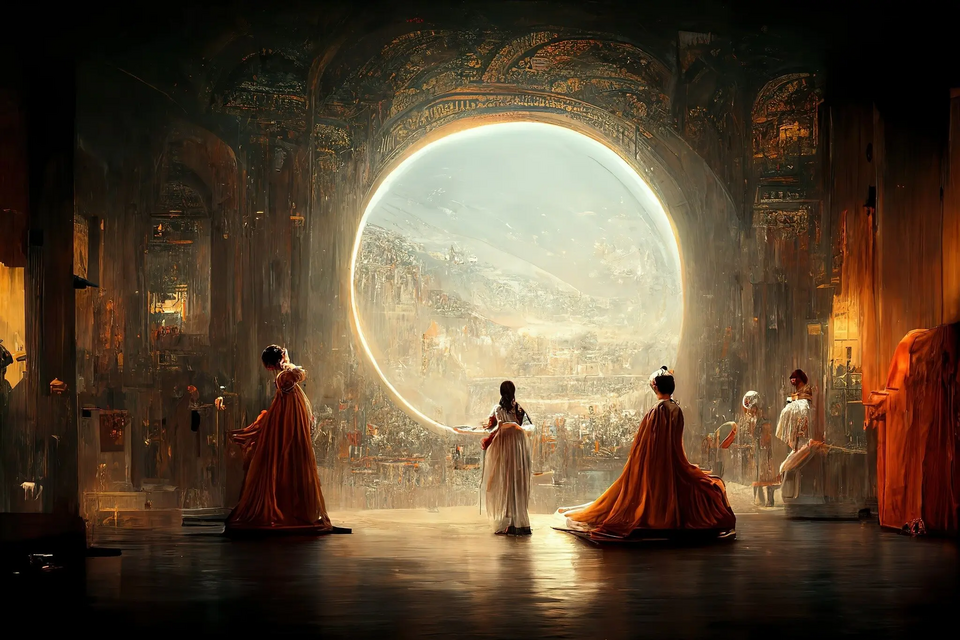
Jason M. Allen's Théâtre D’opéra Spatial was created substantially using generative AI, with additional human editing.
Which tools were used?
The documented workflow has three stages: image generation with Midjourney, changes made in Photoshop, and resolution enhancement with Gigapixel AI. The source describes both generative software and human editing; calling the work AI-generated does not mean a person contributed nothing. [record]
How this check was done
This is a retrospective desk review of published sources, researched on 22 September 2026. It is not new eyewitness reporting. Source statements are identified separately from our conclusions.
What this means when checking an image
Begin with production records and attributable statements. An ornate scene or painting-like surface is not enough to identify a tool. Here, the documented workflow supports the origin finding without an AI-detector score.
The evidence record
The official record describes a mixed workflow.
Page 2 records Allen's explanation: Midjourney produced the initial image; Photoshop was used to change it, and Gigapixel AI increased its resolution. [record]
Limits: This is a recorded account of production, not our inspection of session logs or project layers.
Sources: record
Earlier reporting describes the same sequence.
Smithsonian's September 2022 report describes generation, selection, Photoshop adjustments and upscaling. It also reports a first-place digital-arts award at the Colorado State Fair. [report]
Limits: This reporting predates the official decision but does not provide the underlying project files.
Sources: report
Our conclusion
AI GENERATED: the documented process supports substantial generative-AI involvement. That classification does not erase the selection and editing carried out by a person.
Confidence and limitations
Strong confidence in the broad production method; no precise percentage of human or AI contribution is claimed.
This check concerns origin, not artistic merit, competition fairness or current copyright status. We did not reproduce the workflow. No reproduction licence for the artwork has been established.
Methods, technical checks and limitations
Source and provenance
The review begins with the named work's official administrative record, cross-checked against reporting from the year it was exhibited. [record, report]
Media analysis
No visual-anomaly test was used. A painting-like appearance cannot, by itself, identify the production method.
Metadata and technical findings
No original project or capture file was obtained. Embedded metadata was not independently examined.
Reverse-image and source matching
The two sources identify the same titled artwork and creator. We did not run a reverse-image search or authenticate other images attributed to Allen.
Detector and tool signals
No AI detector was run. No detector score contributes to this verdict.
Independent evidence
The official record and earlier coverage agree on the broad workflow. Both rely in part on the creator's explanations; they are not two independent forensic reconstructions.
Sources and further reading
- Théâtre D’opéra Spatial: Review Board decision
U.S. Copyright Office · primary: official record containing applicant's production account · Accessed 2026-09-22
Source published: 2023-09-05
- Art Made With Artificial Intelligence Wins at State Fair
Smithsonian Magazine · contemporaneous reporting · Accessed 2026-09-22
Source published: 2022-09-06
- Théâtre D’opéra Spatial — file and version history
Wikimedia Commons · media repository; used to identify the displayed web rendition, not as evidence for the verdict · Accessed 2026-09-22
Updates and corrections
- 22 September 2026 — First publication following human review.