The claim
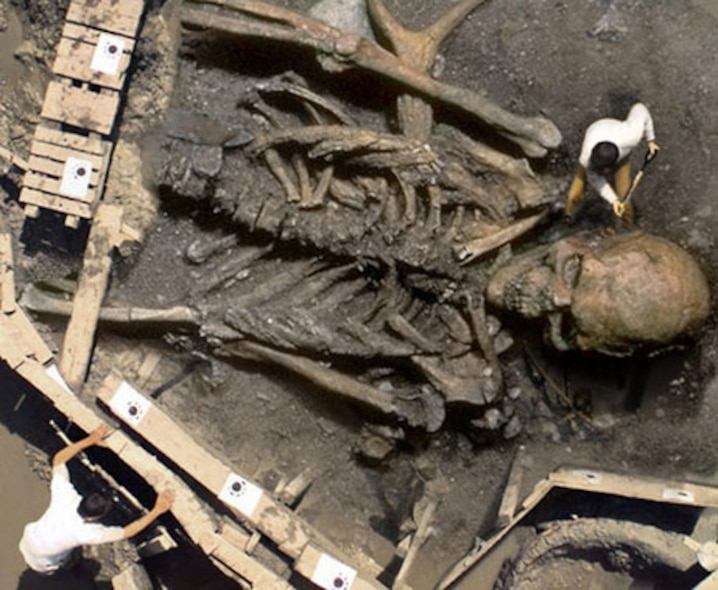
The image known as Giants, showing an enormous human skeleton beside excavation workers, records a genuine discovery associated with National Geographic.
Was this made with generative AI?
The documented method is digital compositing. This case does not establish generative-AI use. A fabricated image can be created through conventional editing, so “fake” and “AI-generated” are different findings.
How this check was done
This is a retrospective desk review of published sources, researched on 22 September 2026. It is not new eyewitness reporting. Source statements are identified separately from our conclusions.
How to check a similar post
Identify the exact image and claim before borrowing a verdict. Trace the earliest accessible version and look for the named excavation’s own records. A familiar-looking skeleton, a dramatic scale difference or a credible-looking logo cannot establish the origin on its own.
The evidence record
The maker's account explains the construction.
National Geographic identifies Giants as IronKite's entry in a 2002 Worth1000 contest. It reports that a human skeleton was added to a photograph of the Hyde Park mastodon excavation. [natgeo]
Limits: We have not obtained the layered editing file or independently recovered the original contest entry.
Sources: natgeo
The excavation has a separate institutional record.
The Paleontological Research Institution documents its 2000 Hyde Park mastodon excavation and includes an aerial site photograph credited to Cornell's Program of Computer Graphics. [museum]
Limits: The museum account corroborates the real setting; it does not itself identify the hoax composite.
Sources: museum
Our conclusion
FAKE: this particular image does not document the claimed giant-human discovery. The identified method is digital compositing; this check does not establish generative-AI use.
Confidence and limitations
Strong confidence for this named historical composite. The finding does not extend automatically to every skeleton image online.
The original editing file and complete repost history were not obtained. This finding concerns the named composite, not every skeleton image online. We make no claim about later sharers’ motives or religious beliefs. A source reproduction is shown for review; no reproduction licence has been obtained.
Methods, technical checks and limitations
Source and provenance
National Geographic's 2007 investigation is the source for the manipulation history. The museum's later first-hand account supplies independent context for the underlying excavation.
Media analysis
This draft does not infer fabrication from unusual anatomy or apparent scale. It relies on the attributed production history.
Metadata and technical findings
No original project or capture file was obtained. Embedded metadata was not independently examined.
Reverse-image and source matching
We reviewed the published source accounts. We did not perform a fresh pixel match, reverse-image search or reconstruction of the composite.
Detector and tool signals
No AI detector was run. No detector score contributes to this verdict.
Independent evidence
The institution's excavation record concerns a mastodon, not a giant human. National Geographic also rejects the alleged discovery attributed to it. [museum, natgeo]
Sources and further reading
- Skeleton of Giant Is Internet Photo Hoax
National Geographic · reporting with creator interview; response by the named organisation · Accessed 2026-09-22
Source published: 2007-12-14
- The Hyde Park mastodon, 13,000 + 20 years later
Paleontological Research Institution · primary: excavation participant's institutional account · Accessed 2026-09-22
Updates and corrections
- 22 September 2026 — First publication following human review.