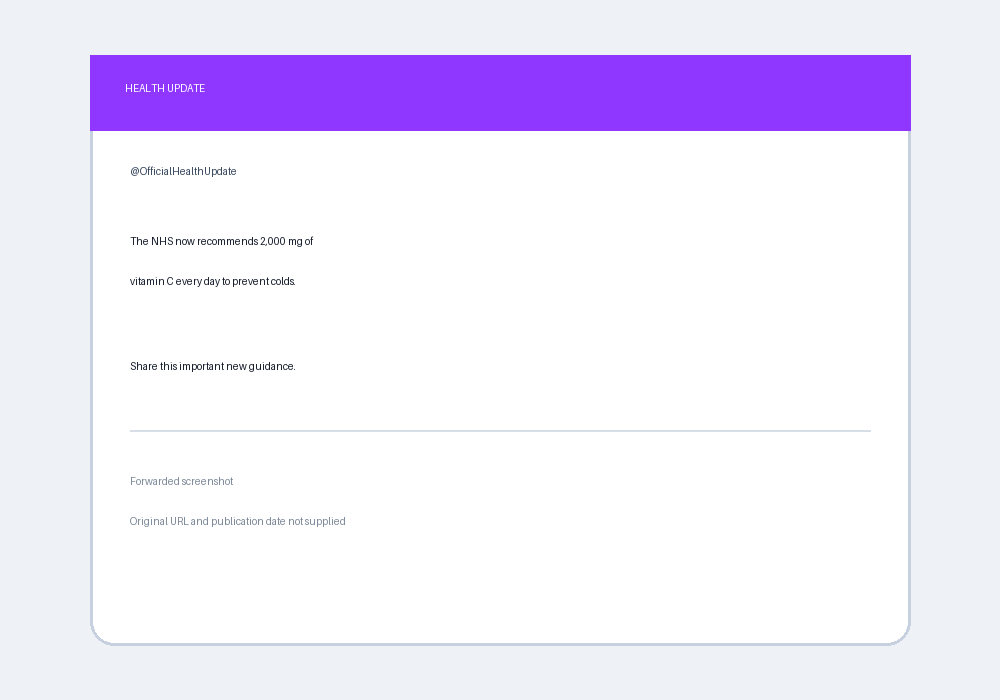
The four questions the report had to keep separate
- Visible content: what words and design elements are actually present in the supplied pixels?
- Factual support: what does reliable health evidence say about taking 2,000 mg of vitamin C daily to prevent colds?
- Attributed source: does the visual appearance establish that the NHS created or published the post?
- File provenance: was the original file, URL, publication date, edit history or machine-readable authenticity information available?
A weak system might combine those questions into “real” or “fake.” Our acceptance gate required separate findings and rejected any report that declared the screenshot authentic merely because its text was readable or its presentation looked plausible.
What factual evidence could address
The screenshot’s health sentence is checkable independently of its source identity. The NHS vitamin C guidance discusses recommended intake and warns that taking more than 1,000 mg a day can cause gastrointestinal symptoms. The Cochrane review of vitamin C and the common cold reports that regular supplementation did not reduce cold incidence in the general population, although it found limited effects on duration and some different evidence in people under short periods of extreme physical stress. The US National Institutes of Health evidence summary provides dosage and safety context.
Those sources help assess the health claim. They do not prove who made the screenshot, whether the visible account existed, or whether an original post was edited or cropped.
What the test required the system to say it had not examined
- No original platform URL or account record was supplied.
- No creation date, first-publication record or surrounding thread was available.
- No original camera or export file was available for metadata inspection.
- No Content Credentials or other machine-readable provenance record was supplied.
- No reverse-image or earliest-source result was provided in the fixture.
Why this matters to users
A screenshot can reproduce a true sentence from a false account, a false sentence from a genuine account, or a genuine post placed in the wrong time and context. Checking only the visible claim misses the source question; checking only the styling misses the factual question. The result must tell the user which evidence supports each conclusion.
The controlled report passed because it produced five distinct findings and five concrete next checks, requested the original source and provenance records, and did not authenticate the screenshot or label it AI-generated. This single fixture does not establish general image-detection accuracy.